 Cosmic Scale
Jupiter
Gas giant · 778 million km from the Sun
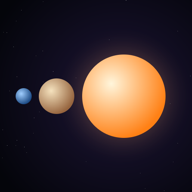
How big is Jupiter?
Jupiter is about 139,800 km across.
See Jupiter in 3D, at true scale
Jupiter has two and a half times the mass of every other planet put together. It is a ball of hydrogen and helium with no solid surface, banded by jet streams and dotted with storms that last for centuries.
At a glance
| Diameter | 139,800 km |
|---|---|
| Mass | 1.90 × 10²⁷ kg |
| Diameter compared with Earth | 11.0 × Earth |
| Year | 11.9 years |
| Day | 9 hours 56 minutes — the fastest |
| Moons | 97 known |
Good to know
- The Great Red Spot is a storm wider than Earth that has been watched for at least 190 years, and is slowly shrinking.
- Its magnetic field is the strongest of any planet, and its auroras are hundreds of times more powerful than Earth's.
- Deep inside, the pressure may squeeze hydrogen into a liquid metal — the source of that magnetic field.
- Next smaller: Saturn · 116,500 km
- Next larger: TRAPPIST-1 · 165,900 km