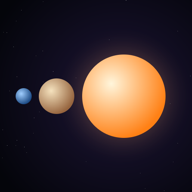
 Cosmic Scale
Planets in order of size: the 8 planets of the Solar System compared
From smallest to largest the planets are Mercury, Mars, Venus, Earth, Neptune, Uranus, Saturn and Jupiter. Jupiter is about 11 times wider than Earth, and Mercury is less than half as wide again as our Moon. The numbers below are mean diameters from NASA.
See planets in 3D, at true scale
| # | Name | Diameter | × Earth |
|---|---|---|---|
| 1 | Mercury Planet | 4,879 km | 0.383 |
| 2 | Mars Planet | 6,779 km | 0.532 |
| 3 | Venus Planet | 12,100 km | 0.950 |
| 4 | Earth Planet | 12,740 km | 1.00 |
| 5 | Neptune Ice giant | 49,240 km | 3.86 |
| 6 | Uranus Ice giant | 50,720 km | 3.98 |
| 7 | Saturn Gas giant | 116,500 km | 9.14 |
| 8 | Jupiter Gas giant | 139,800 km | 11.0 |
Planets
Jupiter
Jupiter has two and a half times the mass of every other planet put together.
Saturn
Saturn's rings are only tens of metres thick but stretch hundreds of thousands of kilometres — countless chunks of nearly pure water ice, from grains to house-sized boulders, each on its own orbit.
Uranus
Uranus was the first planet discovered with a telescope, and it is tipped over: its axis lies almost in the plane of its orbit, so it rolls around the Sun on its side.
Neptune
Neptune was found with mathematics before anyone looked: astronomers noticed Uranus was being tugged off course, calculated where the culprit must be, and pointed a telescope there in 1846.
Earth
The only world we know that has liquid water on its surface, an oxygen atmosphere and life.
Venus
Venus is almost Earth's twin in size, and nothing like it in every other way.
Mars
Mars is a cold desert with seasons, polar caps and the tallest volcano in the Solar System.
Mercury
Mercury is the smallest planet and the closest to the Sun, with almost no atmosphere to even out its temperature.