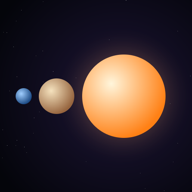
 Cosmic Scale
The Sun
Yellow dwarf · 8.3 light-minutes
How big is The Sun?
The Sun is about 1,391,000 km across.
See The Sun in 3D, at true scale
The Sun is an ordinary yellow dwarf star, and it holds 99.86% of the mass of the Solar System. In its core, 600 million tonnes of hydrogen fuse into helium every second, and a small fraction of that mass becomes the light that keeps Earth alive.
At a glance
| Diameter | 1,391,000 km |
|---|---|
| Mass | 1.99 × 10³⁰ kg |
| Diameter compared with Earth | 109 × Earth |
| Surface | 5,772 K |
| Core | 15 million K |
| Age | 4.6 billion years |
| Fuel left | About 5 billion years |
Good to know
- Light from its core takes tens of thousands of years to struggle out to the surface — then 8 minutes to reach us.
- It converts about 4 million tonnes of matter into energy every second.
- When its hydrogen runs out it will swell into a red giant and swallow Mercury and Venus.
- Next smaller: Alpha Centauri B · 1,201,000 km
- Next larger: Alpha Centauri A · 1,694,000 km