 Cosmic Scale
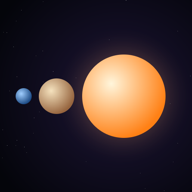
Biggest stars in the universe compared with the Sun
Our Sun is an average star. Red dwarfs like Proxima Centauri are a fraction of its size, while red supergiants such as UY Scuti and Betelgeuse placed where the Sun is, would reach out past the orbit of Mars. The sizes of supergiants are uncertain by tens of percent, because their edges are fuzzy and their distances hard to measure.
See stars in 3D, at true scale
| # | Name | Diameter | × The Sun |
|---|---|---|---|
| 1 | TRAPPIST-1 Red dwarf | 165,900 km | 0.119 |
| 2 | Proxima Centauri Red dwarf | 214,600 km | 0.154 |
| 3 | Barnard's Star Red dwarf | 260,200 km | 0.187 |
| 4 | Epsilon Eridani Orange dwarf | 1,023,000 km | 0.735 |
| 5 | Alpha Centauri B Orange dwarf | 1,201,000 km | 0.863 |
| 6 | The Sun Yellow dwarf | 1,391,000 km | 1.00 |
| 7 | Alpha Centauri A Yellow star | 1,694,000 km | 1.22 |
| 8 | S301 Star orbiting Sagittarius A* | 2,087,000 km | 1.50 |
| 9 | Sirius White main-sequence star | 2,381,000 km | 1.71 |
| 10 | Vega White main-sequence star | 3,284,000 km | 2.36 |
| 11 | S2 Star orbiting Sagittarius A* | 8,488,000 km | 6.10 |
| 12 | Spica Blue giant (binary) | 1.0 × 10⁷ km | 7.47 |
| 13 | Pollux Orange giant | 1.3 × 10⁷ km | 9.06 |
| 14 | Arcturus Red giant | 3.5 × 10⁷ km | 25.4 |
| 15 | Polaris Yellow supergiant | 5.2 × 10⁷ km | 37.5 |
| 16 | R136a1 Wolf–Rayet star | 5.9 × 10⁷ km | 42.7 |
| 17 | Aldebaran Red giant | 6.1 × 10⁷ km | 44.1 |
| 18 | Canopus Bright giant | 9.9 × 10⁷ km | 71.0 |
| 19 | Rigel Blue supergiant | 1.1 × 10⁸ km | 78.9 |
| 20 | Deneb White supergiant | 2.8 × 10⁸ km | 203 |
| 21 | Eta Carinae Luminous blue variable | 3.3 × 10⁸ km | 240 |
| 22 | Pistol Star Blue hypergiant | 4.3 × 10⁸ km | 306 |
| 23 | Rho Cassiopeiae Yellow hypergiant | 8.8 × 10⁸ km | 636 |
| 24 | Antares Red supergiant | 9.5 × 10⁸ km | 680 |
| 25 | Betelgeuse Red supergiant | 1.1 × 10⁹ km | 764 |
| 26 | UY Scuti Red supergiant | 1.3 × 10⁹ km | 909 |
| 27 | Mu Cephei Red supergiant | 1.4 × 10⁹ km | 972 |
| 28 | RW Cephei Red hypergiant | 1.5 × 10⁹ km | 1,100 |
| 29 | Westerlund 1-26 Red supergiant | 1.7 × 10⁹ km | 1,200 |
| 30 | HR 5171 A Yellow hypergiant | 1.8 × 10⁹ km | 1,320 |
| 31 | VY Canis Majoris Red hypergiant | 2.0 × 10⁹ km | 1,420 |
| 32 | KY Cygni Red supergiant | 2.0 × 10⁹ km | 1,420 |
| 33 | WOH G64 Hypergiant | 2.1 × 10⁹ km | 1,540 |
| 34 | Stephenson 2-18 Red supergiant | 3.0 × 10⁹ km | 2,150 |
Stars
Stephenson 2-18
Stephenson 2-18 is a red supergiant near the star cluster Stephenson 2, and one of the largest stars ever proposed.
WOH G64
WOH G64 is a hypergiant in the Large Magellanic Cloud, wrapped in a thick cocoon of dust it has thrown off.
KY Cygni
KY Cygni is a red supergiant in Cygnus, one of the largest stars in the Milky Way.
VY Canis Majoris
VY Canis Majoris is a red hypergiant losing mass at a spectacular rate, wrapped in a nebula of its own making.
HR 5171 A
HR 5171 A is a rare yellow hypergiant, and rarer still for having a companion star so close that the two touch, sharing an envelope of gas.
Westerlund 1-26
Westerlund 1-26 is a red supergiant in Westerlund 1, the most massive young star cluster in the Milky Way.
RW Cephei
RW Cephei is a red hypergiant, one of the largest stars known.
Mu Cephei
Mu Cephei is a deep red supergiant that William Herschel called 'a most beautiful garnet colour' — hence its nickname, the Garnet Star.
UY Scuti
UY Scuti is a pulsating red supergiant in the constellation Scutum, and for years it topped the lists of the largest known stars.
Betelgeuse
Betelgeuse is the red shoulder of Orion and the most famous star waiting to explode.
Antares
Antares is the red heart of Scorpius, a supergiant so large that if it replaced the Sun it would swallow the orbit of Mars.
Rho Cassiopeiae
Rho Cassiopeiae is a yellow hypergiant, one of the rarest kinds of star, about half a million times brighter than the Sun; in the Sun's place it would reach into the asteroid belt.
Pistol Star
The Pistol Star is a luminous blue variable near the centre of the galaxy, hidden behind so much dust that it was only found in the 1990s with infrared eyes.
Eta Carinae
Eta Carinae is one of the most massive and luminous stars in our galaxy, about 5 million times brighter than the Sun.
Deneb
Deneb marks the tail of Cygnus the Swan and one corner of the Summer Triangle.
Rigel
Rigel is a blue supergiant marking Orion's foot, and one of the most luminous stars visible to the naked eye.
Canopus
Canopus is the second-brightest star in the night sky and a favourite of spacecraft: its brightness and position make it an excellent reference point for navigation far from Earth.
Aldebaran
Aldebaran is the red eye of Taurus the Bull, an orange giant that has swollen to 44 times the Sun's width.
R136a1
R136a1 is the most massive star known: around 200 Suns packed into a Wolf–Rayet star in the Tarantula Nebula.
Polaris
Polaris sits almost exactly above Earth's north pole, so it barely moves while the sky turns around it — which made it the navigator's star for centuries.
Arcturus
Arcturus is an ageing orange giant and the brightest star in the northern half of the sky.
Pollux
Pollux is the brightest star in Gemini and the closest giant star to the Sun.
Spica
Spica, the brightest star in Virgo, is really two hot blue stars orbiting each other every four days, so close that each is pulled into an egg shape by the other.
S2
S2 is a hot young star orbiting Sagittarius A*, the black hole at the centre of the Milky Way.
Vega
Vega was the first star ever photographed and the first to have its spectrum recorded.
Sirius
Sirius is the brightest star in the night sky, partly because it is genuinely luminous and partly because it is close.
S301
S301 is a star a little bigger than the Sun, discovered in 2026 on the tightest known orbit around Sagittarius A*.
Alpha Centauri A
Alpha Centauri A is the closest star to the Sun that is genuinely Sun-like: same type, slightly larger and brighter, and about the same age.
The Sun
The Sun is an ordinary yellow dwarf star, and it holds 99.86% of the mass of the Solar System.
Alpha Centauri B
Alpha Centauri B is the slightly smaller, cooler partner in the closest star system to the Sun.
Epsilon Eridani
Epsilon Eridani is a young orange dwarf, a little smaller and cooler than the Sun, only 10.5 light-years away.
Barnard's Star
Barnard's Star moves across our sky faster than any other star — a tenth of the Moon's width each century.
Proxima Centauri
Proxima Centauri is the closest star to the Sun, a small red dwarf gravitationally tied to the bright pair of Alpha Centauri.
TRAPPIST-1
TRAPPIST-1 is a cool red dwarf barely larger than Jupiter, and it has seven Earth-sized planets — the largest family of rocky worlds known around one star.