 Cosmic Scale
What if the Sun became a black hole?
The Sun squeezed into a black hole 6 km across: the planets keep their orbits, but the light and heat are gone
A what-if: physics allows it on paper, but no one has ever seen one. Everything shown follows the theory as it stands.
Step by step
The same pull
Newton showed in 1687 that outside a round body its pull is the same as if all its mass sat at the centre: the shell theorem. Einstein's gravity agrees, by Birkhoff's theorem of 1923: outside a round mass, space has the same shape whatever the mass inside is doing. So a black hole of one Sun would pull on Earth exactly as the Sun does now.
Only two things would change: there would be no more sunlight, and no more of the Sun's heat. The rest of this story is what that would mean, worked out with measured numbers. No such thing has ever happened, and it cannot happen to our Sun.
How it could be made
Nature cannot do this to the Sun. Black holes are born when a star of more than about 20 Suns runs out of fuel and its core falls in on itself. What is left must weigh more than about 2.3 Suns, or it stops as a neutron star: the heaviest one known, PSR J0952−0607, has 2.35 Suns (Romani and others, 2022).
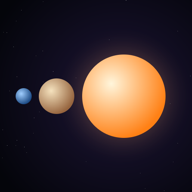
So this is a thought experiment: the Sun is simply swapped for a black hole of the same mass. Squeezing it for real would set free hundreds of times more energy than the Sun gives out in its whole life; that is left out here. The picture shows the shrinking on a sliding scale.
Eight minutes of sunshine
Would Earth feel a change in the pull sooner? Changes in gravity also travel at the speed of light: in 2017 the gravitational waves of the neutron star crash GW170817 arrived within two seconds of its light, after 130 million years on the way. Here, though, there is no change to send: the hole pulls just as the Sun did.
The Moon and the planets shine only by the Sun's light, so they would go out too, each when its last reflected light reached us: the Moon within three seconds of the Sun, Jupiter more than an hour later, and Neptune about 8 hours later.
A black sky
With no sunlight to scatter, the air no longer glows blue, so the sky by day is as black as by night. The Moon would vanish, seen only where it hides stars. The hole is far too small to show in the picture, so its place is marked.
The cold
How fast it gets there is worked out with a simple model: rock that brings heat up from below, and air above it that lets heat out to space. The greenhouse effect fades as the cold freezes the water vapour, and later the carbon dioxide, out of the air. Winds bringing warmth from the sea, which would slow the land's cooling at first, are left out.
The sea freezes over
So the sea would not freeze solid in a year or a century: under a lid of ice, liquid water would last for tens of thousands of years. The temperatures and the thickness of the ice are this model's, and a fuller model could give somewhat different ones.
Life in the dark
Life on the surface, which lives on food plants make from sunlight, would die out within months. But some life never needed the Sun: it feeds on chemicals from the rock, on the sea floor and deep underground.
In 1977 the submarine Alvin found hot springs on the floor of the Pacific near the Galápagos Islands, crowded with giant tube worms, clams and crabs. They live on microbes that get their energy from hydrogen sulfide in the water rising from the rock, not from light.
Many of those microbes, and the animals, still breathe oxygen made by plants in sunlight and dissolved in the sea. Without the Sun no more would be made, so the springs' larger animals would die out as it ran low. Microbes that need no oxygen would carry on.
Deeper still, in 2008 a bacterium, Desulforudis audaxviator, was found living alone 2.8 km down a South African gold mine, fed by water split by the radioactivity of the rock (Chivian and others). Life like that could go on in the dark for millions of years.
Close up
The black holes photographed by the Event Horizon Telescope, M87* in 2019 and Sagittarius A* in 2022, show a ring of light because gas falls into them and is heated. Round the Sun's hole space would be almost empty, so it would have no glow: it would be seen only by how it bends the sky.
The bending of the stars' light in the picture follows general relativity, ray by ray. The stars themselves are drawn, and the sky is made brighter than it would look, as if to eyes long used to the dark.
Stretched apart
Closer in, it would pull a body into a long thin strand, which astronomers call spaghettification, long before it reached the horizon. Where the Sun's surface used to be, 696,000 km out, the stretch is less than a millionth of Earth's gravity: the tide depends on how close you are, not on how small the hole is.
Big holes are gentler at their edge. At the horizon of Sagittarius A*, four million times heavier, the stretch on a person is far less than Earth's gravity, and you could cross it without feeling a thing. The rings in the picture mark where the stretch is one and ten times Earth's gravity.
What will really happen
A star becomes a black hole only if it is born with more than about 20 times the Sun's mass. The Sun will instead run out of hydrogen in its core, swell to some 200 times its width and throw off its outer layers. Its hot core will be left as a white dwarf, about as big as Earth, slowly cooling for trillions of years.
Earth will keep going round it, if it is not swallowed by the red giant first, and the night sky will hold a small, fading white star instead of a Sun. The simulation The Sun's death, in Phenomena, shows how it will really end.
The nearest black hole known, Gaia BH1, is 1,560 light-years away (El-Badry and others, 2023). It is ten times heavier than the Sun, and a Sun-like star circles it, just as Earth would circle a Sun turned black hole.
Objects in this story
More simulations
- S301: the fastest known star
- Comet Shoemaker-Levy 9 hits Jupiter
- The asteroid that ended the dinosaurs
- How a star is born
- Pulsar
- Earth's magnetic shield
- The Sun's death
- A star torn apart
- A massive star explodes
- Type Ia supernova
- How black holes are made
- Two black holes merge
- Two neutron stars collide
- Magnetar
- Quasar
- Gravitational lensing
- The brightest gamma-ray burst
- The Milky Way meets Andromeda
- The Big Bang