 Cosmic Scale
Type Ia supernova
A white dwarf that explodes, the nickel that makes it shine for weeks, and how its brightness measured the accelerating universe
Step by step
A dead star that explodes
A Type Ia supernova is a white dwarf, the ember of a dead Sun-like star, blowing itself apart. This one is being fed by a companion star.
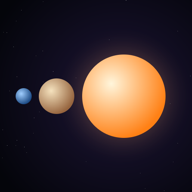
Some white dwarfs have a companion close by. Gas streams from it onto the white dwarf and settles in a hot disc, so the white dwarf slowly gains mass. In the picture the white dwarf is drawn many times larger than to scale, so that it can be seen next to its companion.
The tipping point
Before it reaches the limit, the centre becomes dense and hot enough for carbon to start fusing. Where the extra mass comes from is not settled: gas from a companion, or a merger with another white dwarf. SN 2011fe, caught within hours of exploding in 2011, showed no sign of a giant companion (Li et al., 2011).
Runaway
Fusion in a white dwarf cannot make the star expand and cool, as it would in a Sun-like star, so it runs away: the flame heats the gas and the hotter gas burns faster. Models suggest the flame starts slowly and then turns into a supersonic detonation. Exactly how is still debated.
Nickel, cobalt, iron
Nickel-56 is radioactive, and its decay, then cobalt-56's, sends out gamma rays that heat the thick debris and make it shine. Without them the explosion would fade quickly. Much of the iron around us, including in our blood, is thought to have been made in explosions like this.
The light curve
Real Type Ia supernovae differ a little: the brighter ones fade more slowly, a relation found by Mark Phillips in 1993 that lets astronomers correct for it. This simple model assumes all the gamma rays stay trapped, so it fades more slowly than real ones do after about two months.
Objects in this story
More simulations
- S301: the fastest known star
- Comet Shoemaker-Levy 9 hits Jupiter
- The asteroid that ended the dinosaurs
- How a star is born
- Pulsar
- Earth's magnetic shield
- The Sun's death
- A star torn apart
- A massive star explodes
- How black holes are made
- Two black holes merge
- Two neutron stars collide
- Magnetar
- Quasar
- Gravitational lensing
- The brightest gamma-ray burst
- The Milky Way meets Andromeda
- The Big Bang