 Cosmic Scale
Exoplanets compared with Earth and Jupiter
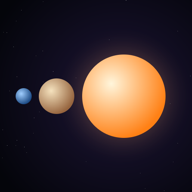
Planets around other stars come in sizes our Solar System lacks: rocky worlds bigger than Earth and puffy gas giants wider than Jupiter.
See exoplanets in 3D, at true scale
| # | Name | Diameter | × Earth |
|---|---|---|---|
| 1 | TRAPPIST-1e Rocky exoplanet | 11,720 km | 0.920 |
| 2 | Kepler-452b Super-Earth | 20,770 km | 1.63 |
| 3 | 55 Cancri e Lava super-Earth | 23,950 km | 1.88 |
| 4 | TrES-4b Puffy hot Jupiter | 250,300 km | 19.6 |
| 5 | HAT-P-67b Inflated hot Saturn | 299,200 km | 23.5 |
Exoplanets
HAT-P-67b
HAT-P-67b is one of the largest planets known and one of the least dense — a Saturn-mass world blown up to more than twice Jupiter's width, trailing a vast cloud of escaping helium.
TrES-4b
TrES-4b is a hot Jupiter so puffed up by its star's heat that its density is lower than cork.
55 Cancri e
55 Cancri e is a super-Earth so close to its star that its year lasts 18 hours and its day side may be an ocean of magma.
Kepler-452b
Kepler-452b was announced in 2015 as the closest thing yet to an Earth twin: a slightly larger world orbiting a Sun-like star on a 385-day year, right in the habitable zone.
TRAPPIST-1e
TRAPPIST-1e is one of seven Earth-sized planets orbiting a small red dwarf 40 light-years away.