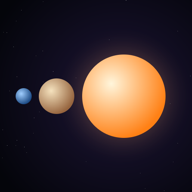
 Cosmic Scale
Biggest moons in the Solar System, in order of size
Ganymede, Jupiter's largest moon, is the biggest moon in the Solar System and wider than the planet Mercury. Saturn's Titan comes second, and our own Moon is fifth.
See moons in 3D, at true scale
| # | Name | Diameter | × Earth |
|---|---|---|---|
| 1 | Deimos Moon of Mars | 12.4 km | 0.001 |
| 2 | Phobos Moon of Mars | 22.2 km | 0.002 |
| 3 | Mimas Moon of Saturn | 396 km | 0.031 |
| 4 | Miranda Moon of Uranus | 472 km | 0.037 |
| 5 | Enceladus Moon of Saturn | 504 km | 0.040 |
| 6 | Tethys Moon of Saturn | 1,062 km | 0.083 |
| 7 | Dione Moon of Saturn | 1,123 km | 0.088 |
| 8 | Charon Moon of Pluto | 1,212 km | 0.095 |
| 9 | Iapetus Moon of Saturn | 1,469 km | 0.115 |
| 10 | Oberon Moon of Uranus | 1,523 km | 0.120 |
| 11 | Rhea Moon of Saturn | 1,528 km | 0.120 |
| 12 | Titania Moon of Uranus | 1,577 km | 0.124 |
| 13 | Triton Moon of Neptune | 2,707 km | 0.212 |
| 14 | Europa Moon of Jupiter | 3,122 km | 0.245 |
| 15 | The Moon Earth's moon | 3,475 km | 0.273 |
| 16 | Io Moon of Jupiter | 3,643 km | 0.286 |
| 17 | Callisto Moon of Jupiter | 4,821 km | 0.378 |
| 18 | Titan Moon of Saturn | 5,149 km | 0.404 |
| 19 | Ganymede Moon of Jupiter | 5,268 km | 0.413 |
Moons
Ganymede
Ganymede is the largest moon in the Solar System — bigger than Mercury — and the only one with a magnetic field of its own, generated by a molten iron core.
Titan
Titan is the only moon with a thick atmosphere, and the only world besides Earth with liquid on its surface — though its rivers, lakes and rain are methane and ethane, not water.
Callisto
Callisto is the most heavily cratered object in the Solar System — a surface so old and so unchanged that it records four billion years of impacts.
Io
Io is squeezed between Jupiter's gravity and the pull of the other large moons, and the friction melts its insides.
The Moon
The Moon formed when a Mars-sized body struck the young Earth and the debris pulled itself together in orbit.
Europa
Beneath Europa's cracked shell of ice lies an ocean holding perhaps twice as much water as every ocean on Earth combined.
Triton
Triton orbits Neptune backwards, which almost certainly means it did not form there: it is a captured object from the Kuiper Belt, seized by Neptune's gravity.
Titania
Titania is the largest moon of Uranus, a world of ice and rock split by enormous canyons that may have cracked open as its interior froze and expanded.
Rhea
Rhea is Saturn's second-largest moon, a heavily cratered ball of ice with a little rock.
Oberon
Oberon is the outermost of Uranus's large moons, an old, cratered world of ice and rock.
Iapetus
Iapetus is Saturn's two-faced moon: its leading side is as dark as coal and its trailing side as bright as snow.
Charon
Charon is half the width of Pluto, so the two do not simply orbit one another: they both circle a point in empty space between them, always showing each other the same face.
Dione
Dione is an icy moon of Saturn with bright ice cliffs streaking its trailing side.
Tethys
Tethys is a mid-sized moon of Saturn made almost entirely of water ice.
Enceladus
Enceladus hides a global ocean of salty water beneath an icy shell.
Miranda
Miranda is the smallest of Uranus's five large moons and one of the strangest-looking worlds known: a patchwork of grooved terrain, giant cliffs and smooth plains, as if it had been shattered and pieced back together.
Mimas
Mimas is the smallest body in the Solar System still rounded by its own gravity.
Phobos
Phobos is the larger moon of Mars and orbits closer to its planet than any other moon in the Solar System, only 6,000 km above the surface.
Deimos
Deimos is the smaller and outer of the two moons of Mars, a lumpy, dusty body barely 12 km across.