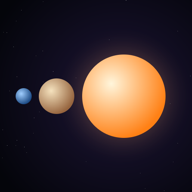
 Cosmic Scale
How big is the universe?
The scale of space, from asteroids to the observable universe
The observable universe is about 93 billion light-years across: that is the region whose light has had time to reach us in the 13.8 billion years since the Big Bang. That is about 6.9 × 10¹⁹ times wider than Earth, and 9.3 × 10⁵ times wider than our galaxy.
Zoom from an asteroid to the universe in 3D
The ladder of sizes
Each step below is a real object, and the last column says how many times wider it is than the one before. Together they span about 24 powers of ten.
| Object | Diameter | Step up |
|---|---|---|
| Bennu Near-Earth asteroid | 490 m | – |
| Halley's Comet Periodic comet | 11.0 km | 22.4× |
| Ceres Dwarf planet | 939 km | 85.4× |
| The Moon Earth's moon | 3,475 km | 3.70× |
| Earth Planet | 12,740 km | 3.67× |
| Jupiter Gas giant | 139,800 km | 11.0× |
| The Sun Yellow dwarf | 1,391,000 km | 9.95× |
| Betelgeuse Red supergiant | 1.1 × 10⁹ km | 764× |
| UY Scuti Red supergiant | 1.3 × 10⁹ km | 1.19× |
| Solar System The Sun and its planets, out to Neptune | 9.0 × 10⁹ km | 7.11× |
| Oort Cloud Shell of icy bodies around the Sun | 3.16 light-years | 3,330× |
| Orion Nebula Star-forming nebula | 24.0 light-years | 7.59× |
| Milky Way Barred spiral galaxy | 100,000 light-years | 4,170× |
| Local Group Our group of 80+ galaxies | 10 million light-years | 100× |
| Laniakea Supercluster Our home supercluster | 520 million light-years | 52.0× |
| Hercules–Corona Borealis Great Wall Largest known structure | 10 billion light-years | 19.2× |
| Observable Universe Everything we can ever see | 93 billion light-years | 9.30× |
If Earth were a grain of sand
- Earth: a grain of sand 1 mm wide.
- The Sun: a ball 11 cm wide, 11.7 m away.
- The nearest star, Proxima Centauri: 3,160 km away.
- The Milky Way: 74 million km across.
- The observable universe: 69 trillion km across, about 460,000 times the real distance from Earth to the Sun.
Questions
How big is the universe?
The observable universe is about 93 billion light-years across. It is wider than 13.8 billion light-years because space has kept expanding while the light was on its way. The whole universe beyond what we can see may be far larger, or infinite; nobody knows.
How big is the Milky Way?
About 100,000 light-years across, with a few hundred billion stars. Light takes about 100,000 years to cross it.
How many Earths fit in the Sun?
About 1.3 million Earths would fit inside the Sun by volume.
What is the biggest thing in the universe?
The largest structure known is the Hercules–Corona Borealis Great Wall, a wall of galaxies about 10 billion light-years long. Its size is still debated, as is whether walls this large fit the standard picture of the cosmos.